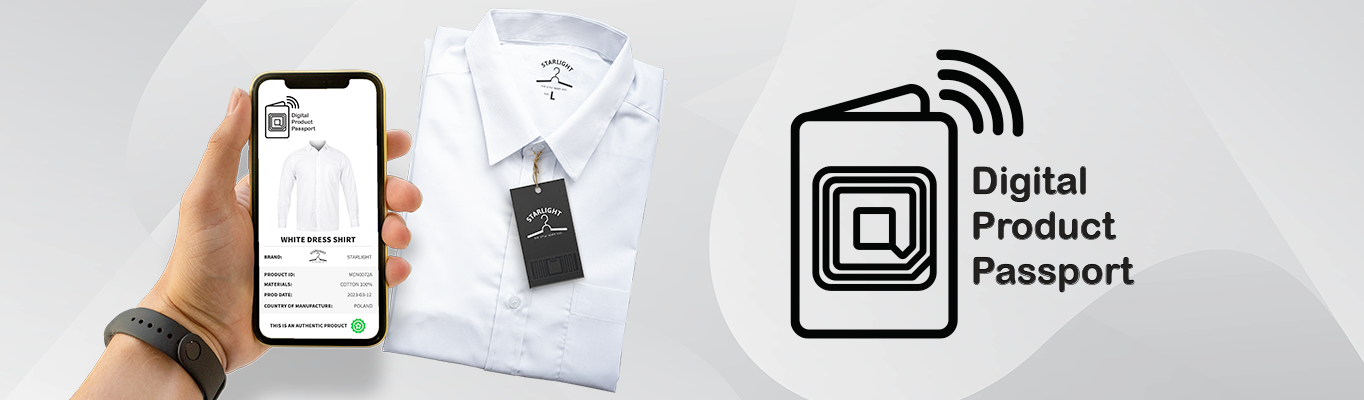
As part of Ecodesign for Sustainable Products Regulation (ESPR), the Digital Product Passport (DPP) is one of the key initiatives created under the EU’s Circular Economy Action Plan (CEAP). The idea is to lay the groundwork for a cross-sectoral DPP based on unified guidelines, principles, taxonomy, and standards, to ease the EU’s transition towards a circular economy.
Its primary objective is to collect data on a product and its supply chain, and then to share it across the entire value chain, as the lack of information concerning products is widely seen as a barrier to circular economy strategies. Digital Product Passport aims to improve traceability and transparency along the entire value chain of a product. It also intends to better the management and sharing of product-related data, responsible for ensuring their sustainable usage, circularity and prolonged life. DPP details a product’s origin, composition, repair, and disassembly options and outlines how the various components can be recycled.
The main goal of this initiative is to gradually introduce the Digital Product Passport in at least three major markets (textiles, construction, industrial and electric vehicle batteries) and at least one major value chain (consumer electronics, packaging, and food) by 2024. That is for the near future, later to be expanded to more product categories. The digital product passport was implemented to support sustainable product production, businesses to create value through circular business models, consumers to make more informed purchasing decisions and to verify compliance with legal obligations.
Regarding moving toward more sustainable business practices, we can find textiles, construction, electronic waste, plastics, chemicals, and automotive sectors among the most pressured sectors. The criteria for each type of Digital Product Passport will be determined by the various materials, processes, and data protection requirements relating to each product.
RFID is an optimal tool for the purposes of implementation of Digital Product Passport. Not only does it offer an immediate identification of every single item, but it also allows scanning without a product in sight. As a result, all bulk operations are more efficient and bring significant savings in processes such as verification of origin upon delivery or inventory control. RFID also enables storing additional data directly on the product if required. With all its advantages and features, RFID responds to the most pressing needs and issues related to the implementation of the Digital Product Passport.